
Environmental Scientist Resume Example & Template for 2026
Studies environmental systems, conducts field assessments, and develops solutions to environmental problems including pollution, conservation, and climate impact.
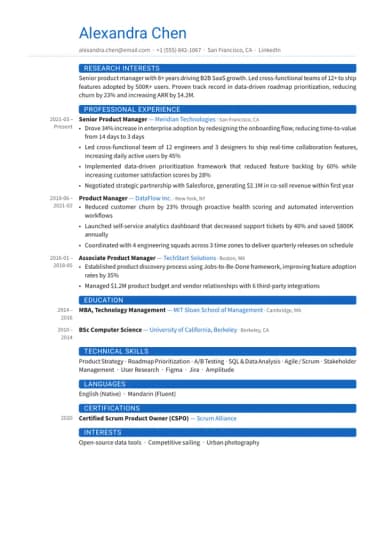
Recommended template: Academic
ATS-Friendly (score 4/6)Academic format for publications, grants, and research
Scholarly format with colored heading bars and date-sidebar layout.
What skills should a Environmental Scientist put on their resume?
Mid-Level (3-7 years)
Must-have
Nice-to-have
How to write Environmental Scientist experience bullets
Start each bullet with a strong action verb and quantify your impact with metrics. Here are the most effective verbs by experience level:
Junior action verbs
Mid-Level action verbs
Senior action verbs
Key phrases for your resume summary
Include these terms in your professional summary to signal relevance to both ATS systems and recruiters:
What certifications help a Environmental Scientist get hired?
These certifications appear most frequently in Environmental Scientist job listings. Include them in a dedicated certifications section on your resume.
- 40-Hour HAZWOPER
- Professional Wetland Scientist (PWS)
- QEP (Qualified Environmental Professional)
- PE
Environmental Scientist career path: Junior to Senior
Junior
0-3 years experience
Bachelor's in Environmental Science, Ecology, or related field
5 core skills · 1 certifications
Mid-Level
3-7 years experience
Bachelor's or Master's in Environmental Science
6 core skills · 2 certifications
Senior
7-15 years experience
Master's or PhD in Environmental Science or related field
7 core skills · 2 certifications
Example bullets for a Environmental Scientist resume
Adapt these examples with your own metrics and achievements. Each bullet follows the formula: action verb + task + measurable result.
- Published 18 peer-reviewed papers in high-impact journals (Nature Methods, PNAS) with cumulative citation count exceeding 450, establishing expertise in computational protein design.
- Secured $2.4M in competitive funding as PI/Co-PI across 5 grants from NIH, NSF, and private foundations, supporting research program of 3 postdocs and 5 graduate students.
- Developed novel assay methodology reducing experimental turnaround from 3 weeks to 4 days, adopted by 6 laboratories internationally and published as open-source protocol.
- Mentored 8 graduate students and 4 postdoctoral researchers, with 100% placement rate in tenure-track positions or industry research roles within 6 months of completion.
Example professional summary
“Accomplished Environmental Scientist with expertise in Environmental Impact Assessment, Regulatory Compliance, Project Management, Field Investigation. Drives environmental science, environmental assessment, regulatory compliance through rigorous methodology, collaborative research, and a commitment to advancing knowledge in the field.”
5 expert tips for your Environmental Scientist resume
1Lead with publications and research outcomes
Publication count, h-index, and journal impact factors signal research productivity. Include a selected publications section or 'X peer-reviewed publications in journals including Y and Z.'
2Show funding acquisition track record
Grant funding is the lifeblood of research. State amounts secured, agencies funded by (NIH, NSF, DOE), and your role (PI, Co-PI). 'Secured $1.2M NIH R01 as Principal Investigator' is extremely strong.
3Include technical methods and equipment
Name Environmental Impact Assessment, Regulatory Compliance, Project Management, Field Investigation and specific methodologies, instruments, and techniques relevant to your field. Research hiring managers filter on methodological expertise.
4Demonstrate mentorship and collaboration
Show students supervised, postdocs mentored, and interdisciplinary collaborations. Research is increasingly team-based — collaborative ability is a strong hiring signal.
5Balance academic depth with industry relevance
For industry research roles, translate academic experience into business terms. Show how your research led to patents, product improvements, or process innovations rather than focusing solely on publications.
Frequently Asked Questions
What are the most important skills for a Environmental Scientist resume?+
How long should a Environmental Scientist resume be?+
What certifications should a Environmental Scientist include on their resume?+
Should I tailor my Environmental Scientist resume for each application?+
Related resume examples
Research Scientist
Designs and conducts scientific experiments, analyzes data, and publishes findings to advance knowledge in a specialized field.
View example →Laboratory Technician
Performs laboratory tests, maintains equipment, and supports research by preparing samples and recording data.
View example →Biostatistician
Applies statistical methods to biological and health science data, designing studies and analyzing results for clinical trials and research.
View example →Clinical Trial Manager
Manages the execution of clinical trials from site selection through close-out, ensuring regulatory compliance, timelines, and data quality.
View example →Geoscientist
Studies the physical structure, composition, and processes of the Earth through fieldwork, laboratory analysis, and modeling.
View example →Frontend Developer
Builds user-facing web interfaces with modern JavaScript frameworks and CSS.
View example →Backend Developer
Designs and builds server-side logic, APIs, and database systems.
View example →Full-Stack Developer
Works across frontend and backend to build complete web applications.
View example →Your Environmental Scientist resume, tailored in minutes
29 ATS-tested templates. Tailored to your target role.
Build your resume now