
Site Reliability Engineer Resume Example & Template for 2026
Ensures system reliability, scalability, and performance through engineering practices.
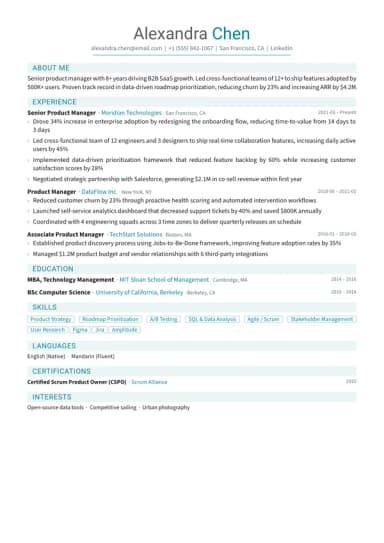
Recommended template: Modern
ATS-Friendly (score 4/6)Clean, modern layout preferred in tech hiring
The globally recognized Awesome-CV design. Colorful header with icons.
What skills should a Site Reliability Engineer put on their resume?
Mid-Level (2-5 years)
Must-have
Nice-to-have
How to write Site Reliability Engineer experience bullets
Start each bullet with a strong action verb and quantify your impact with metrics. Here are the most effective verbs by experience level:
Mid-Level action verbs
Senior action verbs
Key phrases for your resume summary
Include these terms in your professional summary to signal relevance to both ATS systems and recruiters:
What certifications help a Site Reliability Engineer get hired?
These certifications appear most frequently in Site Reliability Engineer job listings. Include them in a dedicated certifications section on your resume.
- AWS Solutions Architect
- Kubernetes (CKA)
- Google Professional Cloud DevOps Engineer
Site Reliability Engineer career path: Mid-Level to Senior
Mid-Level
2-5 years experience
Bachelor's in Computer Science, IT, or related field
7 core skills · 2 certifications
Senior
5-10 years experience
Bachelor's in Computer Science or related field
8 core skills · 2 certifications
Example bullets for a Site Reliability Engineer resume
Adapt these examples with your own metrics and achievements. Each bullet follows the formula: action verb + task + measurable result.
- Architected and deployed a microservices platform handling 2M+ daily requests, reducing average response time by 40% and eliminating single points of failure.
- Led migration from monolithic architecture to event-driven system, cutting deployment time from 4 hours to 15 minutes and enabling independent service scaling.
- Implemented automated CI/CD pipeline with comprehensive test coverage, reducing production incidents by 60% and deployment frequency from weekly to multiple times daily.
- Mentored a team of 4 junior engineers through code reviews and pair programming sessions, resulting in 30% faster onboarding time and improved code quality metrics.
Example professional summary
“Results-driven Site Reliability Engineer with expertise in Linux, Python, Monitoring, Kubernetes. Proven track record of building scalable, maintainable systems and delivering measurable business impact through site reliability, uptime, scalability.”
5 expert tips for your Site Reliability Engineer resume
1Lead with technical impact, not responsibilities
Instead of listing what you were responsible for, show what you built and its measurable impact. Quantify with metrics: latency reductions, uptime improvements, users served, or deployment frequency gains.
2Match your skills section to the job listing
ATS systems rank candidates partly on keyword overlap between your resume and the listing. Include Linux, Python, Monitoring, Kubernetes if you have genuine experience with them — but never list tools you cannot discuss in an interview.
3Show system design thinking at senior levels
Beyond individual contributions, demonstrate architectural decisions: why you chose a specific technology, how you handled scale, what trade-offs you evaluated. This separates senior engineers from mid-level contributors.
4Include a projects section if you lack work experience
For early-career Site Reliability Engineer roles, side projects, open-source contributions, and hackathon entries demonstrate practical skill. Link to live deployments or GitHub repositories where possible.
5Keep your resume ATS-compatible
Use a single-column layout with standard section headings (Experience, Education, Skills). Avoid tables, multi-column layouts, and images — ATS parsers frequently misread or skip these elements.
Frequently Asked Questions
What are the most important skills for a Site Reliability Engineer resume?+
How long should a Site Reliability Engineer resume be?+
What certifications should a Site Reliability Engineer include on their resume?+
Should I tailor my Site Reliability Engineer resume for each application?+
Related resume examples
Frontend Developer
Builds user-facing web interfaces with modern JavaScript frameworks and CSS.
View example →Backend Developer
Designs and builds server-side logic, APIs, and database systems.
View example →Full-Stack Developer
Works across frontend and backend to build complete web applications.
View example →Mobile Developer
Builds native or cross-platform mobile applications for iOS and Android.
View example →DevOps Engineer
Automates infrastructure, builds CI/CD pipelines, and manages cloud deployments.
View example →Security Engineer
Protects systems and data by designing and implementing security measures.
View example →Data Engineer
Designs and maintains data pipelines, warehouses, and processing systems.
View example →Machine Learning Engineer
Builds and deploys machine learning models into production systems.
View example →Your Site Reliability Engineer resume, tailored in minutes
29 ATS-tested templates. Tailored to your target role.
Build your resume now